

In healthcare, first impressions happen in seconds. A patient walks through the door, scans the room, and forms an opinion about the team before anyone says a word. Appearance carries more weight in that moment than most organizations want to admit. Healthcare staff uniform branding is not about looking polished for its own sake.
It is about signaling competence, calm, and credibility the instant someone walks in. When a clinic or hospital gets this right, patients feel safer, and staff feel more grounded. Both outcomes are worth chasing.
We’ve seen it again and again: when uniforms look intentional, patients feel more at ease and staff feel more confident. In this blog, we’re breaking down how healthcare uniform branding helps hospitals and clinics build trust from the first impression on.
Why Uniform Branding Actually Matters in Healthcare
A team in coordinated, clearly branded clinic staff apparel signals that the organization is organized and intentional.
Even if every person on that team is brilliant, a mismatched group in different colors and styles can plant quiet doubt in a patient’s mind.
Consistent uniforms also reduce real confusion in busy clinical settings. When each department wears a distinct color or style, patients and visitors orient themselves faster. Staff can identify who belongs to which team without stopping to ask. That clarity keeps things moving and cuts down on the friction everyone could do without.
There is a staff-side benefit too. Staff who wear well-designed, cohesive uniforms tend to feel more confident and more connected to their team. A name badge tells people your name. A branded uniform tells them where you belong, what your role represents, and that your organization thought carefully about how you show up every day.
The Building Blocks of a Strong Healthcare Uniform Program
A solid hospital employee uniform program starts with the brand itself. Colors, logo style, and visual identity should carry through every piece of apparel. That does not mean grabbing the cheapest scrubs and stamping a logo on them. It means choosing pieces that work with the brand palette, placing the logo thoughtfully, and ensuring every department sits within a cohesive system.
Department-specific color coding is one of the most practical tools in healthcare workwear branding. When nursing staff wear one color, admin teams another, and allied health a third, patients can navigate the environment more intuitively. It removes guesswork and adds a layer of professionalism that people notice even if they cannot explain why.
Functional needs vary by role, so the program has to account for that. A surgical tech has completely different requirements than a front desk coordinator. The visual system stays consistent while the actual garments flex to meet what each role demands day to day.
Choosing the Right Apparel: Scrubs, Polos, and Everything In Between
Medical office-branded scrubs are the obvious starting point for clinical staff. Practical, familiar, and easy to brand. But not everyone in a healthcare setting belongs in scrubs. Front desk staff, practice managers, and patient coordinators often need something that reads a bit more polished while staying on-brand. Polos, structured jackets, or layering pieces work well in those roles.
The key is to maintain the same visual language across all garment types. If the scrubs carry a specific logo placement and color scheme, the polos and jackets should mirror that. The brand should feel consistent whether someone is drawing blood in the back or checking patients in at the front.
Fabric performance matters more in clinical settings than almost anywhere else. Staff are on their feet for long shifts, moving constantly, and washing their uniforms daily. Garments that pill, shrink, or fade after a few cycles are not just annoying; they’re also a waste of money. They undermine the polished appearance that the whole program was built around. Durable, comfortable, high-performance fabrics are a baseline, not a bonus.
Logo Placement, Decoration Methods, and Getting the Details Right
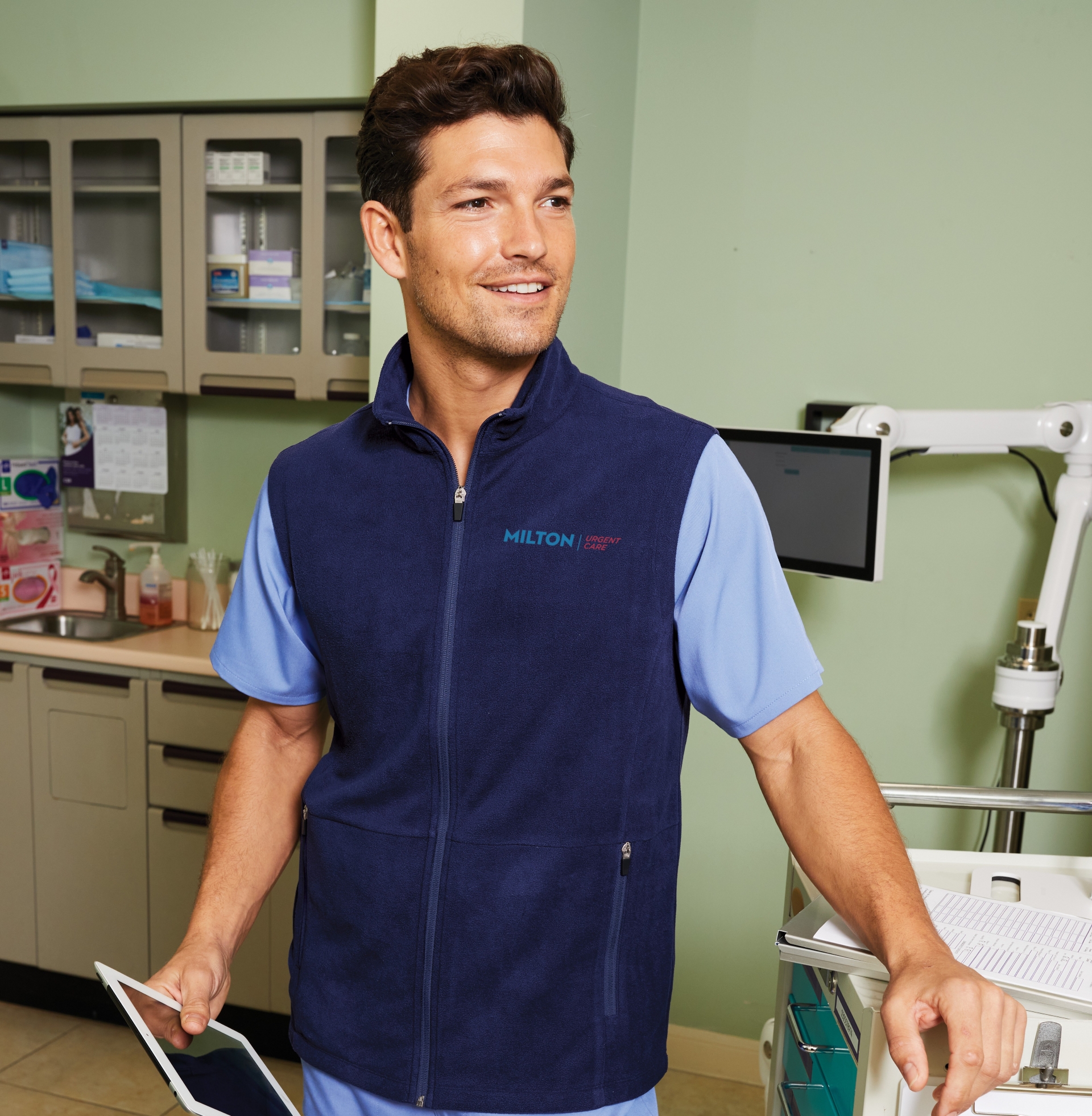
Embroidery is usually the best move for healthcare workwear branding, for a few very practical reasons.
It holds up through repeated industrial washing, looks clean and professional, and does not peel or crack over time. Screen printing and heat transfer can work in some contexts, but for clinical apparel that is washed this frequently, embroidery wins on durability every time.
Placement matters just as much as method. The left chest is the most common location for scrub branding. It keeps the logo visible and professional without interfering with movement or pocket access. Some organizations add secondary branding on sleeves or the back yoke, particularly on outerwear and jackets. The goal is visibility without clutter.
Hygiene considerations should inform every decoration decision. Raised embellishments or complex decoration in areas that come into direct contact with patients are worth skipping. Clean, flat, well-positioned embroidery keeps things sharp without creating unnecessary hygiene concerns.
Sizing, Inclusivity, and Making Sure Everyone Feels Represented
A uniform program that does not fit everyone on the team is not a uniform program. It is a source of frustration. Extended size ranges are not optional if the goal is real staff buy-in. When people feel like an afterthought in the sizing conversation, they check out of the whole program.
Offering unisex, fitted, and relaxed cuts within the same uniform line gives staff genuine choice without breaking the visual system. The logo and color stay consistent. The fit adapts to the individual. That combination is what makes people want to wear the uniform rather than just tolerate it.
Involving staff in the selection process, even a simple sample review or a quick preference survey, dramatically improves adoption. When people have a voice, they feel a sense of ownership. When they feel a sense of ownership, they wear the uniform with more pride and take better care of it.
Running a Uniform Program That Actually Holds Together Over Time
The launch is the easy part. Sustaining a hospital employee uniform program as the team grows and shifts is where most organizations struggle. The fix is building simple systems early.
New hire onboarding should include a uniform kit from day one. Nobody should show up for their first shift scrambling for the right gear. A ready-to-go kit tells the new team member they belong and that the organization was prepared for them. Reorder processes need to be predictable. A supplier who can manage inventory and fulfill replacement orders without a months-long wait keeps everything running without drama.
Replacement cycles and laundering guidance should be communicated clearly to staff so garments stay looking sharp longer. As teams grow or departments shift, the program should flex without requiring a full rebuild every time.
Where Righteous Fits Into Your Healthcare Apparel Program
We approach healthcare workwear differently than a generic promo supplier would. We are not here to hand over a catalog and wish you luck. We work with clinics and healthcare organizations to understand the brand, team structure, functional requirements, and budget, then build a program that actually makes sense for all of them.
That usually means sorting out who needs what, how departments should look distinct, where the logo belongs, and how reorders will work before anyone places an order.
If you’re ready to build or refresh your healthcare uniform program, reach out to Righteous, and we’ll help you get it right from the start.