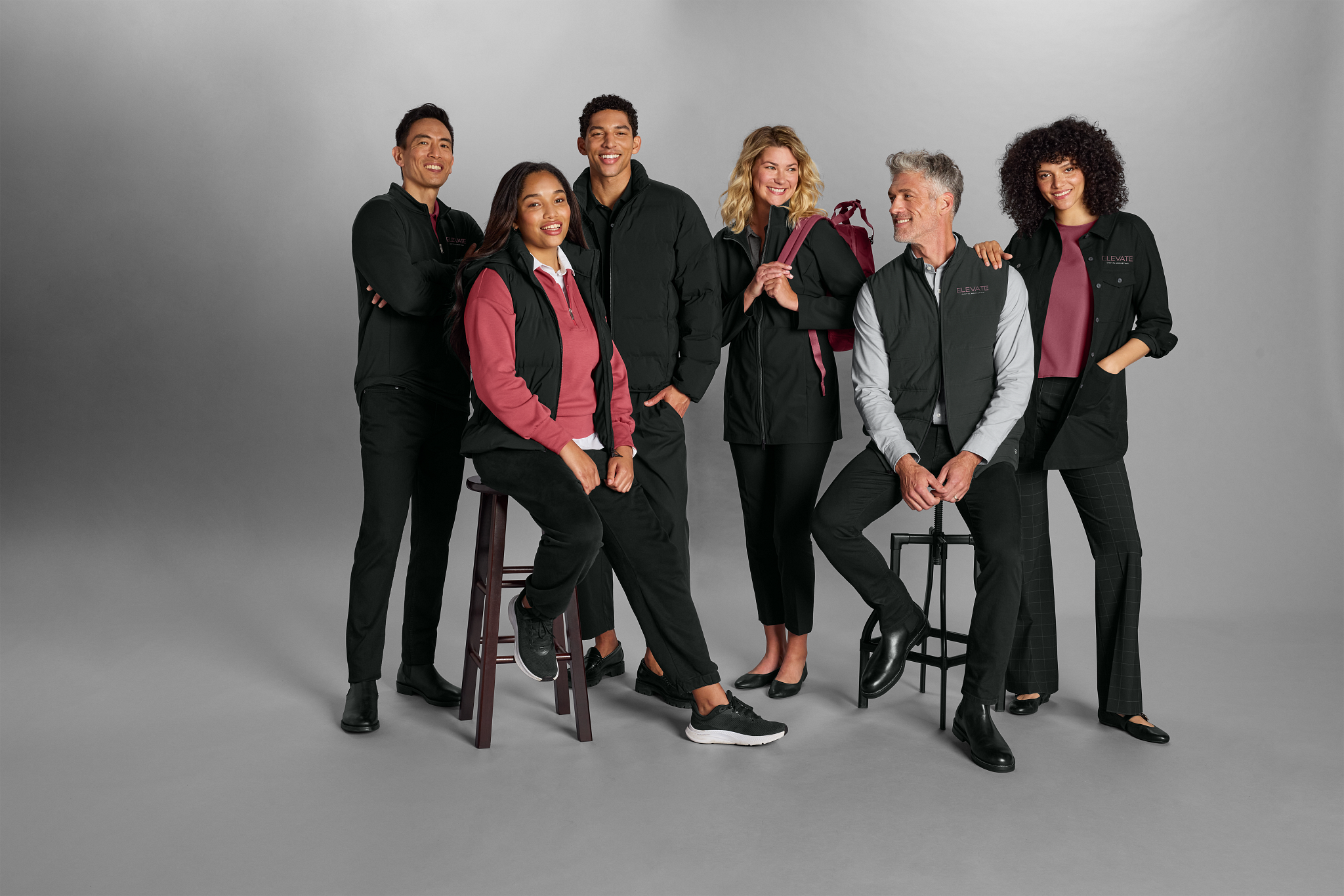

Every growing team hits this fork in the road. You add a couple people, then a few more, and one day you look around and realize everyone’s wearing something slightly different. Now you need matching gear that doesn’t look like it was thrown together on a Friday afternoon. That’s when the question lands: do you rent your uniforms or buy them outright?
The real question underneath uniform rental vs. buying for business isn’t “which one is cheaper this month.” It’s “which one costs less once your team doubles, someone quits, and three new hires need gear by Monday.” We’re walking through both models, the fees, the fine print, and the actual math, so you can make the call fast and get back to work.
The Two Options, Minus the Sales Pitch
Renting means you pay a recurring fee, and a provider handles the garments, washing, and swaps. That bill shows up every month whether you love the shirts or you’re sick of them. Buying outright means you pay once, own everything, and decide what happens next.
Renting vs. buying employee uniforms usually comes down to convenience versus control. Rental fits teams that want zero laundry involvement and shrug off a monthly charge. Buying fits teams that want ownership, better quality, and no contract hanging over their heads.
What Rental Really Costs Over Time
Rental looks harmless on the first invoice. You see a small per-employee fee and think, “That’s nothing.” Then it never stops. That fee is charged every month, to every person, for as long as you stay in the program.
The cost of uniform rental programs adds up quietly. A modest per-person monthly charge can add up to thousands a year when you multiply it across a full team. Stretch that over three or four years, and you’ve often paid several times what the garments were worth in the first place.
The Fees Nobody Warns You About
Here’s where it gets fun. Rental contracts love their add-ons. Damage fees when a shirt catches a stain. Lost-garment fees when something goes missing. Weekly minimums even when your headcount dips. Skim the fine print, and you’ll pay for uniforms nobody’s wearing.
Then there are the auto-renewal clauses. Blink, and you’ve signed on for another multi-year term. Try to leave early and the exit penalties bite. A uniform ownership vs. rental contract comparison almost always tips toward ownership once these surprise line items show up.
What Buying Outright Costs (and Saves)
Buying means a bigger number upfront. No point pretending otherwise. You purchase the gear, decorate it, and it’s yours. The trade? No recurring bill nibbling at your account month after month.
Ownership pays for itself faster than most teams expect. In many uniform rental vs. buying-for-business scenarios, the break-even point falls somewhere between year one and year two. After that, every month you’d have handed over a rental fee is money you keep. You also get resale value on unused stock, easy reprints when your logo changes, and the freedom to add pieces whenever you feel like it.
The Growing-Team Factor Everyone Forgets 
Here’s the part of the rental math conveniently glossed over: growing teams don’t stay one size. Headcount shifts everything.
When you own your uniforms, onboarding a new hire means grabbing a shirt off the shelf. No contract amendment, no waiting for a provider to add someone to the account. Sizing changes, turnover, and replacement swaps stay simple because you’re managing your own inventory instead of a paperwork chain. Fast-scaling teams feel this most. Every new hire in a rental program is another recurring fee locked in for years.
Maintenance, Laundry, and Who Handles It
Rental’s big pitch is laundry. The provider picks up, cleans, and returns garments on a set schedule. That’s genuinely handy, and for some teams it’s worth the price.
But running your own uniforms isn’t the chore people assume it is. Most modern branded apparel washes fine at home, and your team already does laundry. The time cost is tiny. Quality is where the gap widens. Rental garments cycle through industrial washing over and over, so they thin out, fade, and start looking tired. Gear you own and pick can be built to hold up, which is a big reason we fuss over fabrics and stitching in our branded apparel offerings.
Contracts vs. Freedom: Reading the Fine Print
Rental runs on contracts. Multi-year commitments, lock-in terms, and renewal clauses that trigger whether you’re watching or not. If the service slips or your needs change, you’re stuck until the term runs out.
Own the gear, and you call the shots. Want to switch styles? Do it. Change your logo? Reprint. Scale down? No penalty. Teams hunting for an alternative to Cintas or Aramark rental tend to name the same gripe: exit costs and switching headaches. A uniform ownership vs. rental contract decision is a choice between freedom and being tied down. The IRS also draws an important distinction between renting and buying business property, which is worth understanding when you’re comparing long-term costs.
And if you’re evaluating vendors before committing, the fine print matters just as much as the headline price. The right questions upfront can expose contract terms, service limits, and costs that don’t always make it into the first proposal.
So, Which One Actually Costs Less?
Let’s run a few scenarios. A small team of five might find rental painless at first, but even they usually break even on ownership within two years. A mid-size team of thirty watches those recurring fees pile up fast and saves real money by buying. A fast-scaling team? Ownership wins nearly every time, because each new hire in a rental plan is another locked-in cost.
The break-even math is plain: add up what rental costs per person per year, multiply by headcount, then compare it to a one-time purchase. Once your rental spend passes the purchase price, everything after is savings. For a visual walkthrough, this breakdown of uniform program costs lays it out.
When teams weigh renting vs. buying employee uniforms with us, the pattern holds: ownership costs less over time and comes with far fewer strings. We help teams step off the rental treadmill by building buy-out programs that don’t need a laundry service to make sense.
FAQs
Is it cheaper to rent or buy employee uniforms?
Buying often costs more upfront but can be less expensive over time because you avoid recurring rental fees, service charges, and long-term contracts.
What hidden costs should businesses watch for in uniform rental contracts?
Common extras can include damage fees, lost-garment charges, minimum weekly billing, auto-renewals, and early termination penalties.
When does buying uniforms make the most sense for a growing team?
Buying can be a strong fit for teams adding employees regularly, since you control inventory, replacements, styles, and future orders without increasing a recurring rental commitment.
Get Off the Rental Treadmill
If recurring fees, contract terms, and constant headcount changes are making your uniform program harder than it needs to be, there’s another way to run it. Righteous builds buy-out apparel programs around your actual team, growth plans, brand, and budget, so you own the gear and stay in control of what happens next.
Whether you’re replacing a rental program or building one from scratch, talk to Righteous about creating a uniform program that grows with your team without locking you into another rental cycle.